This post contains spoilers for the entire Book of Roses series.
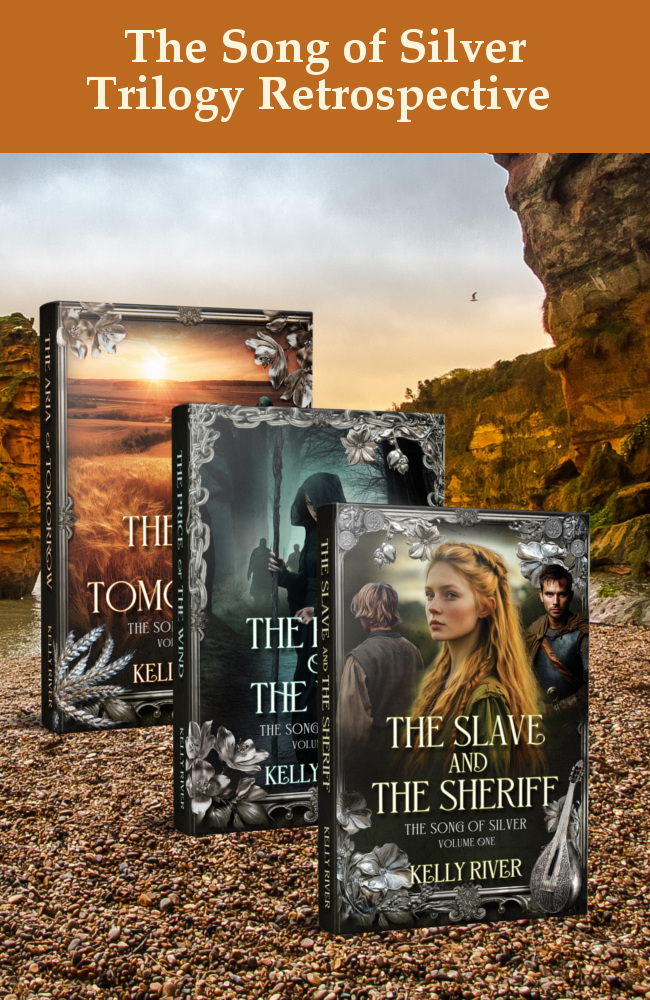
Now that The Song of Silver has concluded and the dust is settling, it’s time for me to do another of my retrospectives on the trilogy. I’ll be delving into some of my inspirations for the story, my writing process, thoughts on the characters, and some overall feelings on how this conclusion to The Book of Roses played out. Spoilers abound, so beware if you haven’t yet read The Slave and the Sheriff, The Price of the Wind, and The Aria of Tomorrow!
Early Planning
Where else to start but the beginning? The Song of Silver initially entered my mind when I was writing the original Book of Roses trilogy, though its concept was very different back then. I always knew that if I wrote a sequel, it would likely feature Elizabeth and Isaac’s children as the protagonists. This first version would have incorporated the events of Lavender’s Wolf and Calia’s Needle into the story, with Livy, Wolfram, and Calia being three of our viewpoint characters.
I quickly realised that this would create two major problems. Firstly, I wanted to take the three characters in such different directions that it would have been difficult to tie their stories together. While I could’ve found ways to do it (perhaps Livy would’ve sold Calia’s tapestries while Wolfram protected their wagons), I didn’t feel that I could do justice to the separate apprenticeships of a merchant, squire, and weaver without the novel becoming bloated or branching in too many directions. If you’re familiar with my storytelling preferences, you know I don’t like books that have multiple disconnected storylines running in parallel.
The second problem was that focusing on the three Merchant siblings would’ve left scant room for other viewpoint characters, namely villains and love interests. My shorter novels typically feature one or two viewpoints, while my longer trilogies each have four, with occasional chapters following side characters. I could’ve expanded the cast, but I prefer narratives that focus on a small number of people in depth rather than large casts that don’t get as much attention. So unless I wanted the Merchant siblings to take up three quarters of my character allotment, I was going to have to make changes.
This, of course, led to me spinning Lavender’s Wolf and Calia’s Needle off into their own self-contained side stories while still giving Wolfram and Calia room to show up in The Song of Silver. I didn’t want the main cast of The Book of Roses to feature prominently. This was always going to be the story of the new generation, and it would’ve done them a disservice if Elizabeth, Isaac, and Kaylein kept showing up to steal the thunder. That being said, I knew people would want to catch up with the old heroes again, so I did my best to pepper them in as and when it felt appropriate.
Inspiration and Characters
Of all odd things, the major creative inspiration behind The Song of Silver was TV crime dramas. At the time of planning The Slave and the Sheriff, I had just finished a re-watch of Breaking Bad and was working my way through The Wire for the first time. I had struggled to settle on an overarching plot for the book, and The Wire gave me the inspiration to centre it around a conflict between outlaws and law enforcement, specifically with an eye to portray heroes and villains on both sides. You can see the crime procedural influence in a lot of Christian’s scenes when he’s combing through evidence in the wake of Catell’s crimes. The Wire also inspired me not to focus the first book on a singular villain, but rather a conflict that had us rooting for and against people on both sides. While Catell’s gang are the clear bad guys, Fen is a victim of circumstance and upbringing who doesn’t deserve his lot in life.
The Breaking Bad influence centred on Christian. When it came to defining the villain for this series, I didn’t want a repeat of Sir Edward. Edward was written to be loathsome and emotionally immature; a temperamental adolescent wielding too much power. I needed The Song of Silver’s villain to be different. The character of Walter White in Breaking Bad is a fantastic example of a hero slowly transforming into a villain. I thought it would be a great creative challenge to try and do something similar.
As long as you have the stomach for it, it’s not all that difficult to write a wretchedly horrible antagonist. You just have them do bad things to good people (especially characters the reader cares about), and let the drama unfold. Christian gave me the opportunity to go in a different direction. He’s clever, he’s principled, and for large portions of The Slave and the Sheriff, he’s presented as the hero. Yet there’s a chink in his armour that allows Catell to slip through and push on his worst impulses. He goes too far, he makes mistakes, and his convictions force him to double down on them. Christian’s final scene with Livy in The Aria of Tomorrow was closely inspired by Walter White’s final scene with his wife in Breaking Bad, in which he finally allows the mask to slip and reveals the truth of his motivations. It wasn’t for the greater good, as much as he tried to tell himself that. It was always for personal reasons.
Of all the main characters, Christian was actually the last one I came up with. Livy and Fen came first. I always knew the book would follow Livy and her merchant ambitions, and Fen’s archetype is one that’s existed in my mind for a very long time. Writing Fen came naturally to me, but Livy was harder to nail down. I knew she was at risk of becoming Elizabeth #2, and to some extent I was okay with that, but I wanted to give her enough distinction to feel like her own person. To that end, I decided she should have more flaws than her mother. Elizabeth was largely a likeable and empathetic character whose conflicts stemmed from life circumstances rather than her shortcomings as a person. Livy is the opposite. Having been raised in a wealthy, loving, and socially liberal household, she has all the opportunities (and more) that a young medieval woman could ask for.
It was the decision to pair Livy with Francis Cairnford that really made her character click for me. I loved the idea of her inheriting a worryingly ambitious streak from her grandfather and allowing him to prey on that. I don’t think Livy’s an unlikeable character in The Slave and the Sheriff, but she’s intentionally combative with her mother, avaricious, and a touch conceited. Livy’s real arc as a character was never to obtain the wealth she craves in the first book, but to learn which riches are truly valuable in life.
Saria was also present in the early planning stage, but she was a very different character. Before Christian existed, Saria was going to be the villain. My idea was to follow an ambitious young nun chasing power in Kaylein’s convent. Ultimately she would’ve been expelled from the order and become the new lady of Kinedwyn when she married Roland, who would’ve taken Sir Roger’s place as the town’s lord after he died. Roland was going to be a secondary villain in this version, with a twisted yet sincere romance playing out between him and Saria as they realised their ruthless souls were made for each other.
This idea of Saria and Roland as villains endured for most of the planning phase. Some of that version still survives in The Slave and the Sheriff. The earliest drafts I wrote included Livy’s first chapter at Wolfram’s wedding. Upon returning to Kingalen, her family are greeted with the news that Sir Roger has taken a bad fall, spurring Livy to ride up to Kinedwyn and check on him. In my first draft, the news of Roger’s fall was actually news of his death, which would’ve set in motion the storyline of Roland arriving to replace him.
I never managed to settle on a compelling long-term plot with Saria and Roland as villains. It would’ve largely been a repeat of storylines from The Book of Roses: conflicts with the Kinedwyn village council, landlords abusing their power, and the common folk trying to push back against cruel nobles. Probably still a fun story, but not one I was passionate about retelling. Once I decided to include Christian, everything else fell into place. If I was going to include a sheriff, I needed lawbreakers for him to clash with, and who better than Fen’s gang? The only character who didn’t fit neatly into that new version was Saria, which is why she has a smaller role in the first book. It took a little longer for her to find her footing, but by the time The Price of the Wind rolled around, I had a clear path in mind for her.
Books Two and Three
Unlike The Book of Roses, I had no idea what books two and three of The Song of Silver would look like when I began. The arcs the characters would go on were fairly clear in my mind, but I didn’t know how they were going to get there.
The Price of the Wind came about as an evolution of an early sequel idea I had back when I was writing The Book of Roses. I’d thought about exploring slavery in a medieval setting, following the journey of a Fen-like character being bought and sold by various owners. That idea never gained much traction, but the concept stuck in my mind. When I settled on the ending for The Slave and the Sheriff, I knew the second book was going to be about slavery.
I didn’t want to focus on the brutal, harrowing hardship of Fen and Livy’s situation. Certainly there were dark moments, but I didn’t want to sustain that level of emotional gravity for an entire novel. I think there are plenty of other stories that have already explored that subject matter in gruesome detail. So I decided to focus on the gilded cage angle instead, contrasting the material luxury of Livy and Fen’s new life with the spirit-crushing deconstruction of their autonomy.
Saria and Christian’s sides of the plot gave me much more trouble. I mentioned earlier that I don’t love novels with multiple storylines running in parallel, and The Price of the Wind ran a serious risk of verging into that territory. I quickly realised that the novel would branch into three separate narratives if I let it, so I made a concerted effort to tie them back together as soon as possible.
This made it the most difficult novel I’ve ever had to write.
On an emotional level, some scenes from The Book of Roses were harder to get through, but The Price of the Wind was a narratively logistical nightmare. Figuring out how to get all my characters to interact consistently, believably, in the same place, at the same time, with compelling motivations and personal stories to drive them, was a lot of work. Time and time again I would come up with an idea, only to ask why? Why would Christian do that? Why would Semila allow this? Why would character X work with character Y? How do I give everyone a reason to preserve Christian’s secret? How do I move the plot forward now that everyone has a reason? And how the heck do I navigate all this to get Livy and Fen free by the end of the novel?
Hopefully it doesn’t come across when you’re reading, but behind the scenes, The Price of the Wind was a mess of strings on corkboard. When you put such dire constraints on what your characters are allowed to say and do, maneuvering the plot in the direction you want becomes much more complicated without slipping into contrivance.
The Aria of Tomorrow was simpler to write, but it took me a long time to settle on the novel’s direction. After Fen and Livy won their freedom, there was a real feeling of “well, what now?” Obviously we still had Christian to deal with, but how would we do that? We could’ve followed Fen on his quest to save Rosceline, but I never planned on making that the substance of the novel. I wanted this final chapter to be about the characters settling into themselves and adopting positions of responsibility after their confinement in The Price of the Wind.
Settling on the idea of Livy reinvesting her fortune into Aria’s Stead was what finally made this click. I like all my novels to focus on different areas of medieval life, and I hadn’t done a story about being a landowner before. This also gave me an opportunity to demonstrate Livy’s growing maturity and empathy via her actions, placing her in the role of leader and custodian; a poignant reflection of Francis Cairnford at the height of his power, yet with a more compassionate heart. Saria fit neatly into this new status quo as Livy’s bailiff, and the Aria gave Christian a new vector of attack that would lead to innocent people getting caught up in the conflict. All the juicy ingredients you need for a good story! This of course laid the groundwork for the conflict between Christian and our heroes to take centre stage. The previous two books dealt with Catell, Edrich, and Semila as antagonists, but for the final volume, I needed it to be all about the main characters.
Personal Favourites
Livy may have been more of a traditional protagonist, but Fen is the one who has my heart. He was actually inspired by the first Dungeons & Dragons character I ever played–an impoverished minstrel boy with a good heart raised in a culture of crime. A rogue and a jester with an endlessly sunny demeanour. I initially planned on introducing Fen later, after Livy’s story got underway, but as I thought about his backstory, I realised it would make for a gripping tale in and of itself, to say nothing of creating a stronger attachment to him as a character. So Fen wound up getting the first three chapters to himself, and I think the opening is far stronger for it. I don’t currently have any plans to tell more stories about Fen (although there’s plenty of ripe territory during those five years he spent abroad with Julius…) but I do expect to write similar characters in the future. The bright and sunny trickster archetype is just too enjoyable for me to leave on the shelf.
Francis Cairnford was another fun character to bring back. Of all the old cast members from The Book of Roses, I didn’t expect him to be the one who got the most page time. But the idea of making him Livy’s mentor was too compelling for me to ignore, and it opened up an opportunity to delve into Francis’s character more deeply than in the previous novels. I’ve always been fascinated by how circumstance can determine whether someone is seen as a hero or villain. Francis doesn’t fundamentally change in The Song of Silver; he’s still a ruthless, bitter, acrimonious man, yet the very thing that made him an antagonist in The Book of Roses–his desire to build a strong family legacy–sets his goals in alignment with Livy’s this time around. Without his wealth and titles, he’s a declawed tiger. While he doesn’t quite find redemption at the end, he at least gets a noble moment defending Clover, perhaps a hint that, in a different life, he could’ve turned his talents to kinder ends.
Another character who gets a touch of dignity in their passing is Christian. The image of him bleeding out in the rainswept tower was one I had in mind long before I settled on the overall ending. I wanted to bring him to his lowest point so he could have one last honest conversation with Livy. Unlike Sir Edward, who earns nothing but indignity and dismissal in the end, I felt that Christian deserved something a little more noble. I considered an ambiguous ending in which he expressed true remorse and limped away to an unknown fate, but after developing his relationship with Stephanie, I realised he would never abandon her. With that in mind, there was only one way Christian’s story could end. He does have a change of heart in his last moments, but by then, it’s too late. That final scene between Livy and Christian is one of my favourites in the entire series.
Ending the Saga
Though I only began publishing The Book of Roses on the cusp of 2024, I first started work on the series way back in 2018. That’s a long time to work on one project! I’m sure I could continue writing books in this setting if I wanted, but by the time I was midway through The Song of Silver, I could feel the fatigue beginning to set in. I never lost my enthusiasm for the series, but I could see it looming on the horizon. I think it’s better to wrap something up while it’s still going strong than to let it fade out with a whimper, so I’ve decided that The Aria of Tomorrow will be the last Book of Roses title for the foreseeable future. Someday I may get the inspiration to return and write more of these novels, but I want it to come naturally rather than forcing it.
If I were to pick a favourite book from the series, it would probably be Mender of Monsters. Perhaps it’s because it’s the most self-contained book, perhaps it’s because I adore Sister Hazel (if I come back to write more stories, she’s a strong contender for the main character), or perhaps it’s because of the dynamic between her and Roger. I have almost entirely positive feelings about Mender of Monsters, whereas most of the other books feature at least one or two things I might do differently if I wrote them again.
Lavender’s Wolf is probably my least favourite in the series, though I still like it a lot. It does unfortunately suffer from some external factors that influenced my writing style at the time. Back then, I had the idea of shopping my books around to literary agents, and I knew that Elizabeth of Rosepath would be a hard sell given its length, genre, and lack of a conclusion. Lavender’s Wolf (and to a lesser extent Calia’s Needle) was supposed to be a secondary entry point into the series, something self-contained and easily digestible that a newcomer could pick up without foreknowledge of the series. I explicitly avoided making direct references to The Book of Roses, which I think harmed the book for readers who moved on to it after The Embers of Daylight. With a touch more integration and continuity, it could’ve flowed as a more natural bridge between the two trilogies.
But those regrets are minor in the grand scheme of things. I’m still very happy with how the Book of Roses saga turned out, and I’m content to close the volume for now and move on to new projects. I have no current timeline for the release of my next book, but stay tuned for more updates and details in the months to come!

