‘My prince was human, I suddenly perceived. It was not reassuring.’
In my review for the previous book in Robin Hobb’s Farseer Trilogy, Assassin’s Apprentice, I noted that the central theme of the story was one of parenting. If that novel was about growing up, this one is about maturity. We see our protagonist Fitz grappling with the tug of his responsibilities versus his emotions, and we delve even deeper into the rich supporting cast. I loved this book just as much as the first, so much so that I could barely tear myself away from the third one to write this review.
While Royal Assassin is a book in the same vein as the previous novel–a character-driven political fantasy–there’s a greater focus on action this time around as Fitz becomes a catalyst rather than a bystander. Now that he’s no longer a boy, he becomes an active participant in the machinations of the royal court–and a target for all the dangers that entails.
Robin Hobb’s character development is one of her strongest suits, and this time around we get a deeper look into a few characters whose surfaces we only scratched the last time. It’s especially satisfying to see Fitz glimpse flaws and vulnerabilities in his parental figures that he was blind to as a boy, especially Burrich and Verity. Verity in particular gets a lot of page time in the first half of this novel, demonstrating his own maturity as he steps deeper into the role of king-in-waiting. The archetype of the noble fantasy king is a difficult one to get right without falling into cliché, but Verity is a shining example of how to nail it. There’s a selfless quality to him that takes a toll on his wellbeing and interpersonal relationships, yet the weight of responsibility he feels to his subjects is truly admirable. Perhaps the defining trait Fitz exhibits is loyalty to his king, and this wouldn’t have worked unless Verity was a man truly worthy of admiration. There are few characters more likeable, so much so that Verity is effectively the protagonist of a more traditional fantasy story going on in parallel to Fitz’s.
Burrich also has a few of his rough edges shaved off, and his emotional arc is perhaps the most satisfying by the time he utters the novel’s final line of dialogue. Prince Regal steps to the forefront as the trilogy’s main antagonist, proving himself even more reprehensible and loathsome than Galen in the previous book. He’s not given the same level of development as the other characters, but he works wonderfully well as a hateable villain. Lady Patience has become a sleeper favourite of mine in this trilogy, and I’m glad to say she has more of a role in this novel as well. As Fitz matures, we see Patience stepping in to mentor him in matters of the heart, an area in which he’s in sore need of guidance this time around.
The romance hinted at in book one blooms fully this time around. This is the only area of the novel that I have slightly mixed feelings about. On the one hand, it does work well to characterise Fitz and his loyalty to his king while creating a lot of dramatic tension around the idea of forbidden love. It’s tied effectively into the plot and doesn’t feel vapid or superfluous. That being said, as the book goes on, romantic scenes are increasingly defined by Fitz and his partner getting into fights with each other. This makes sense; it’s sort of inevitable given their differing values and the teenage infatuation that drives them, but it does make it difficult to get invested in their relationship. By the end, I was actually rooting for Fitz to agree to a political marriage given how ill-suited he and his partner were for each other. I don’t want to say the romance didn’t land, but if the point was for me to root for Fitz and his happily ever after, I wasn’t feeling it. I’m very curious to see where this goes in book three, because there’s a lot of (spoiler-sensitive) potential there, just not in the most conventional way.
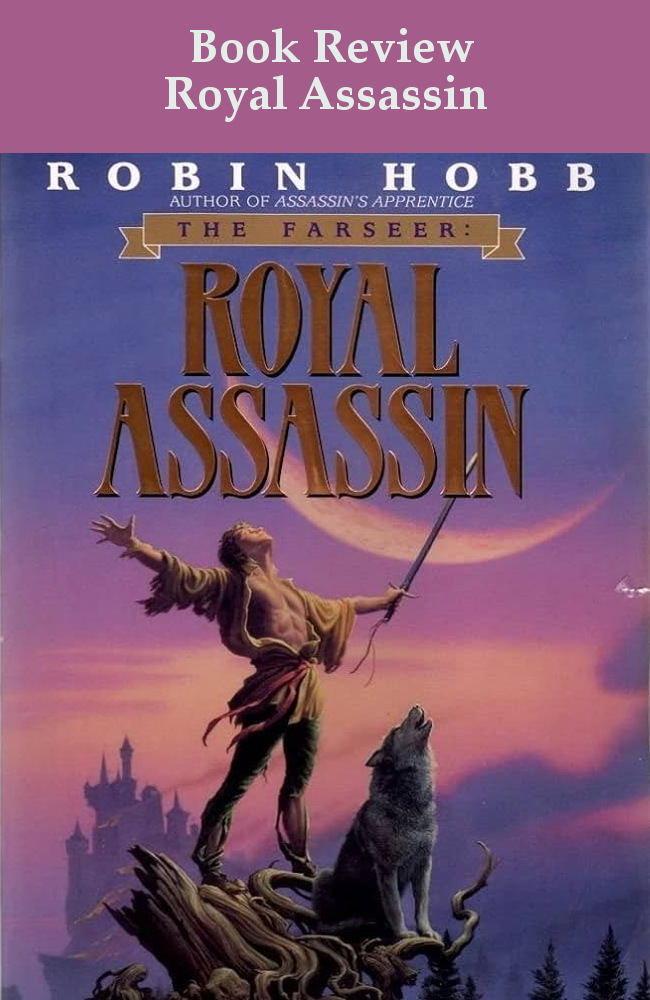
The fantasy elements are also brought slightly closer to the forefront this time around. We’re treated to a little more magic as Fitz forms a mental bond with a wolf cub over the course of the novel. This is a nice way of continuing to explore the magic system while tying it into the ongoing character focus and themes of animal friendship. Fitz goes on a wonderful arc with his wolf, and it winds up being one of the most crucial story threads by the end of the novel. Hobb does a fantastic job of using magic in her setting to explore interesting character details rather than having it serve as a mechanical means to an end. Along with letting us peer into the characters’ deepest thoughts and see how they overlap, it also gives us a very fun and well-written insight into the mind of Fitz’s wolf. Highbrow “what if dogs could talk” content.
Once again, this book is a relatively slow burn that escalates to a truly harrowing climax by the end. The stakes are higher, the consequences are vast, and the twists pull the rug out from under you. Assassin’s Apprentice worked relatively well as a self-contained story, but Royal Assassin absolutely demands you move on to book three. While we aren’t left on a cliffhanger, so much has changed by the end that it’s hard to imagine where things go next. I’m very much looking forward to finishing the final book of this engrossing trilogy.
On a tongue-in-cheek parting note, I found myself thinking that these books must have been named by a publisher looking for a snappy marketing title, or perhaps by Hobb before she knew where the story was headed long-term. Because they’re really not about assassins at all. I’ve been misled for years! If you’d called this the “Low-Fantasy Court Politics Character Drama” trilogy, I would’ve jumped on it way sooner.

