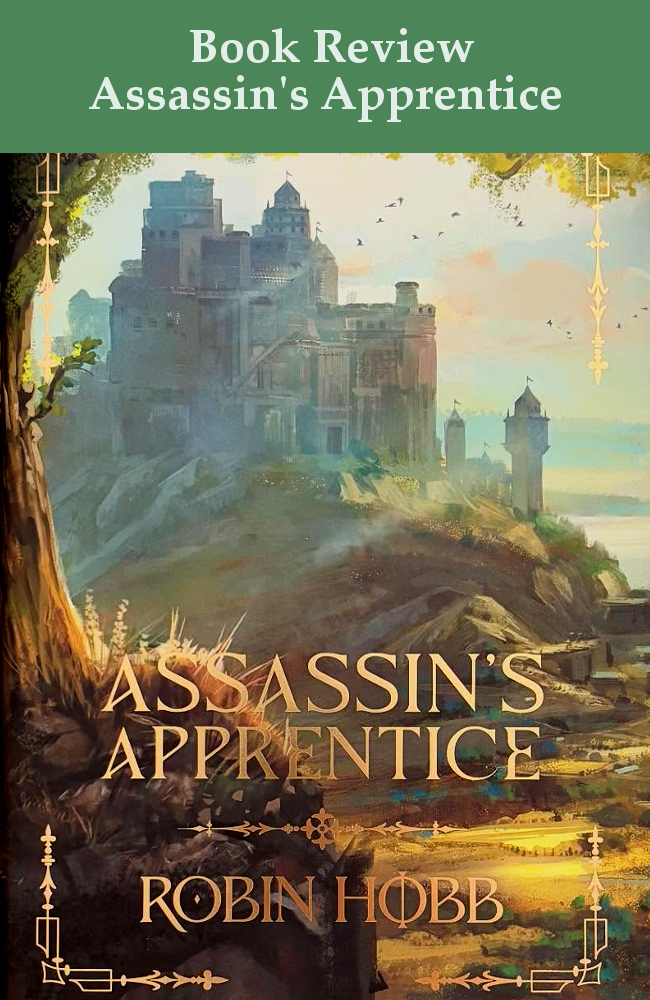
I have to confess, Assassin’s Apprentice is one of those books that sat in my library untouched for far too long. I remember picking it up on a recommendation many years ago, but the title and blurb always called to mind the type of epic fantasy that’s never been my cup of tea.
You know what they say about judging a book by its cover.
When I finally dove into this one, I couldn’t have been happier to be wrong. Rather than the high fantasy swords and sorcery I’d been expecting, I was treated to an enthrallingly low-key, character-driven narrative. Excellent pacing and gripping stakes ramp up the slow burn to a thrilling climax that had me struggling to put the book down. I confess that this one stole a good couple of hours of writing time away from me.
The story follows Fitz, a young bastard of the former crown prince, whose existence is both an embarrassment and an obligation to the royal household. With no clear purpose in mind, his relatives pass him around from caretaker to caretaker until he eventually settles as an apprentice to the court assassin.
Fantasy trappings and political plots aside, the story’s central theme is one of parenting. Most of the chapters revolve around Fitz’s relationship with his parental figures. Be they reluctant, compassionate, pragmatic, or abusive, each one leaves a distinct mark on him. Their interactions are thoughtful and believable, all couched in the responsibilities that tug Fitz’s surrogate family in different directions. You have Burrich, the emotionally distant yet good-hearted stablemaster; Chade, the master assassin who provides a surprising source of kindness and empathy; Lady Patience, the erratic wife of Fitz’s deceased father whose desire to raise her husband’s child wars with her despair at not having borne him herself, and finally Galen, the teacher of a magic known as the Skill whose mental manipulations are a keen allegory for the psychological trauma left by an abusive parent.
With characters this rich, it’s their simple conversations with Fitz that produce the dramatic meat of the novel. I was constantly engrossed every time I got another glimpse into their developing relationships. Peeling back the layers of these characters, feeling warmed by the positive bonds Fitz built with them, then despairing at the scars they left behind, was an emotional rollercoaster that always had me wondering where the story would lead next.
There’s a down-to-earthness to Robin Hobb’s understanding of people that I always admire in fiction. Few characters are archetypal. The good, while still broadly likeable, are often deeply flawed. Burrich the stablemaster is frequently depicted as harsh and intolerant, yet not without good reason. He holds a conservative worldview shaped by his desire to do right by Fitz’s father. This makes the moments of friction and reconciliation between them all the more satisfying, and by the end of the novel, there were few characters I liked more.
Hobb’s handling of magic in her fantasy setting is also praiseworthy. It’s integrated very naturally, not as a bombastic and externally powerful force, but rather as an instinctive means of communication between minds. The Skill delves into thoughts and dreams, unearthing hidden emotions and planting new ones. It can’t change the world, but it can influence the people within it. The meetings of minds during the novel’s few magic sequences offer some wonderful character insights that aren’t immediately apparent, tying into the story’s intense personal themes rather than distracting from them with flash and flair.
Stodgy worldbuilding is an element of fantasy that often drags down the genre for me, and Hobb neatly sidesteps this by telling the story from Fitz’s first-person perspective. Since he’s a child with little education, his knowledge of the world is limited. We’re never subjected to expository sequences detailing how the world works, because these things are largely beyond Fitz’s understanding. We learn along with him, being fed information as and when it’s appropriate. This is complemented by a series of forewords at the start of each chapter, presented in the context of a journal written by (who I presume to be) Fitz’s older self. These asides are only a paragraph or two, never enough to interrupt the pacing, but sufficient to present a scattering of more omniscient observations about history and politics. This does a wonderful job of giving the setting just enough meat to support the story without detracting from the character-driven focus.
As the first in a trilogy, there are plenty of unresolved threads left hanging, but the novel still does a good job of wrapping up the meatiest character conflicts and giving some closure. At its core, this first volume is about Fitz growing up and learning who he is as a person. By the novel’s climax, we get a very clear picture of that. He goes from a wayward child to a young man with strong convictions and loyalties. Many flaws and doubts still plague him (like all the characters, he’s far from perfect), yet with all said and done, I found him to be an immensely likeable protagonist.
Assassin’s Apprentice was a wonderful breath of fresh air for me and a true novel after my own heart. Books like this are the ones that make me want to write. I would thoroughly recommend it to anyone who enjoys thoughtful, character-driven narratives with fantasy seasoning.
I made note of a few favourite lines I wanted to reference in this review. There are a great many poignant observations Robin Hobb makes with her writing, but if I had to pick a favourite, it would probably be one that speaks to the simple themes of humanity and animal friendship that run through the novel:
‘Men cannot grieve as dogs do. But we grieve for many years.’
 Kelly River