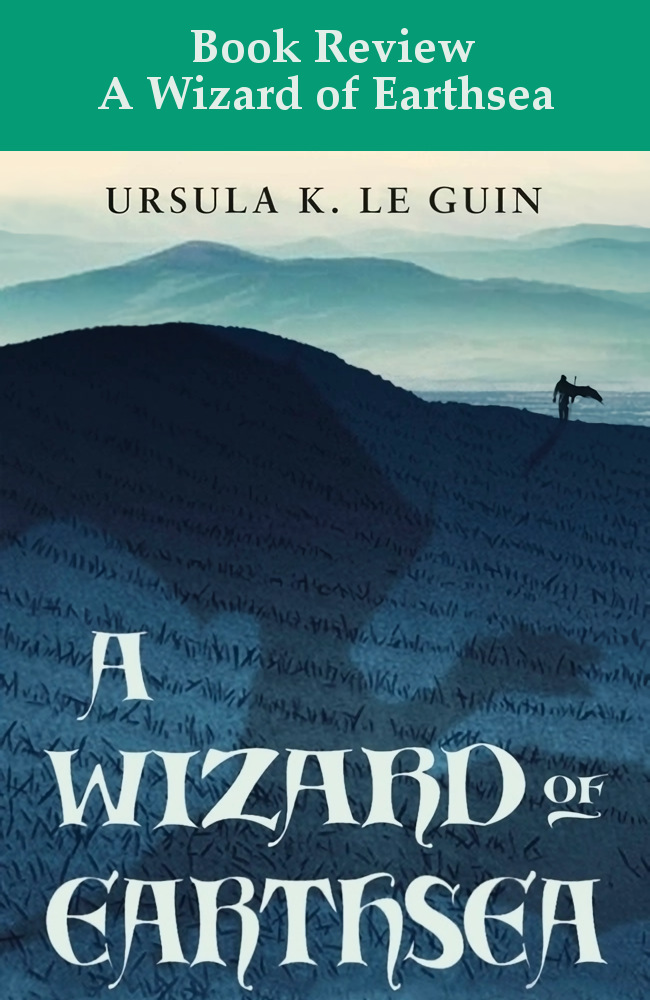
Ursula K. Le Guin’s A Wizard of Earthsea is one of those novels I’ve been peripherally aware of for many years, but I never sat down to give it a read until this autumn. While I wouldn’t say it’s one of my favourite books of all time, I did find it compelling enough to warrant a review. It’s a unique novel, short and sweet, with a wonderful focus on tone that evokes the mood of classic fantasy without getting bogged down in the stodgy prose some novels fall prey to.
Story-wise, this is a relatively simple tale about our titular wizard, Ged, as he grows from a boy into a young man, learning to control his latent magical talents and reaping dark consequences when they go awry. His quest to undo the mistakes of his youth takes him across the archipelago world of Earthsea, where he braves the open waves, tangles with dragons, probes the mysteries of ancient castles, and wins the affection of loyal friends. The page count is relatively low and the pacing is snappy, making for an easy read if you need a palate cleanser between heavier books.
The tone and setting are really the main characters here, with Ged and the supporting cast having just enough personality to make them endearing, but not quite enough to drive the story on their own. Ged’s internal struggle with himself (mirrored by the narrative consequences of dabbling in forbidden magic) is the deepest aspect of character development we see, and it’s an effective parable about a young man coming to accept who he is rather than fighting a self-destructive battle against it.
Worldbuilding is one of those qualities of fantasy writing that’s become a popular point of discussion in recent years, with some readers even holding it up as the defining characteristic of the genre. I tend to agree, but it’s a quality that goes both ways. Underbaked worldbuilding can leave a setting feeling shallow and artificial, while the inverse results in bloated novels that seem more preoccupied with details like what colour of paper the legal clerk of the high temple writes on than what relevance that has to the actual story. For my part, I enjoy worldbuilding that nails the right mood. The details can be light, but they should all be working towards a clear goal. Is the setting gritty, or whimsical? Are its people spiritual, or ascetic? Is it a land of law and order, or freedom and chaos? Do scholars meticulously catalogue the nature of dragons and sorcery, or are these things the purview of legend and folk tale? A gritty, lawful, academic world is going to feel very different from a whimsical, spiritual, free-minded one, and good worldbuilding will make a clear statement on where that line is drawn.
In Wizard of Earthsea’s case, the worldbuilding falls into the simple but focused category. It mainly consists of proper nouns describing far-off places, but these rarely feel redundant. I think that’s because, at its core, the story is about Ged’s narrow experience of the world. It isn’t attempting to draw you into a rich and complex setting layered with factions and geopolitics. Rather, it’s an escapist parable recounted like a folk tale being passed from one generation to the next. Le Guin establishes this from the opening chapter by describing the many heroic events of Ged’s life before winding things back to tell the tale of how it all began. We’re made aware of the broader world, but there’s never a need to explore it in great depth, because that’s not what this story is about. It’s more important to feel like we’re lost on a lonely boat in a vast ocean than it is to understand where the maritime borders lie.
I want to share my favourite line from the book, one that underlined exactly what it was that drew me to Le Guin’s writing:
“Gold is a great thing in Osskil. But it is not a source of good fellowship there.”
Those two sentences perfectly illustrate how she handles worldbuilding. It isn’t deep. It isn’t complex. But it’s concise, eloquent, and just ambiguous enough to let your imagination fill the blanks. Rather than saying “Osskil is a rich and cutthroat town,” she couches the language in a storyteller’s whimsy. It sounds like a warning parable an elder might regale youngsters with. It feels appropriate to the story’s tone, forcing your mind to do just a smidgen of the work while still painting an evocative picture.
That’s not to say the language is perfect throughout. As is often common for the prose of the era, I ran into more than a few run-on sentences that, while grammatically correct, still caused my inner reader to trip over their feet and backpedal to make sense of what I’d read. There are a few awkward lines and redundant phrases like: “Nothing was ahead when he looked ahead,” but for the most part, they fit unobtrusively into the novel’s narrative voice. I’ve always been a proponent of the little details not mattering when the broader picture is solid, and Wizard of Earthsea is solid to its core.
Another thing that drew me to the book was its refreshing honesty. It’s earnest and lacking in cynicism, offering no coy winks to the audience or self-aggrandising attempts to jostle for prominence with its peers. It heralds from an era when the modern fantasy novel was still being codified, following in the wake of Lord of the Rings without verging into the genre’s edgier territory that became popular in the late 20th century. This is something I’ve grown to value a great deal in fantasy. Don’t get me wrong, I love a good gritty and harrowing yarn, but when it comes to fantasy, I’ve always been drawn to the ethereal whimsy of the genre. It’s the romantic unknown that sucks me in; the promise of a world full of secrets and mysteries relayed through hearthside tales and ancient songs.
Accomplishing what Le Guin does requires a confidence that makes no excuses for what it lacks. This is one of those novels that’s obviously weaker on some fronts than others, but it’s weaker because of the style the author was going for, not because they made any mistakes. It’s the kind of fiction that softens itself in some areas to shoot for the stars in others; the sort some people will get turned off by, while others will fall in love with.
I had a friend who would often rave to me about Le Guin’s writing, and I totally get it now. She’s probably not going to become a personal favourite of mine, but I can definitely see the appeal. I feel very enriched for having read A Wizard of Earthsea, and I understand a new corner of the literary world that lived in my blind spot until now.
There’s one last line I took note of that feels like a microcosm of my feelings on the novel and Le Guin’s writing as a whole:
“…there was always such village innocence in Vetch. Yet also he was keen, shrewd, direct to the centre of a thing.”
There’s a village innocence to this book. It’s not grand, but it is keen, shrewd, and direct to the centre of a thing. That, to me, has always been the mark of great writing.
 Kelly River