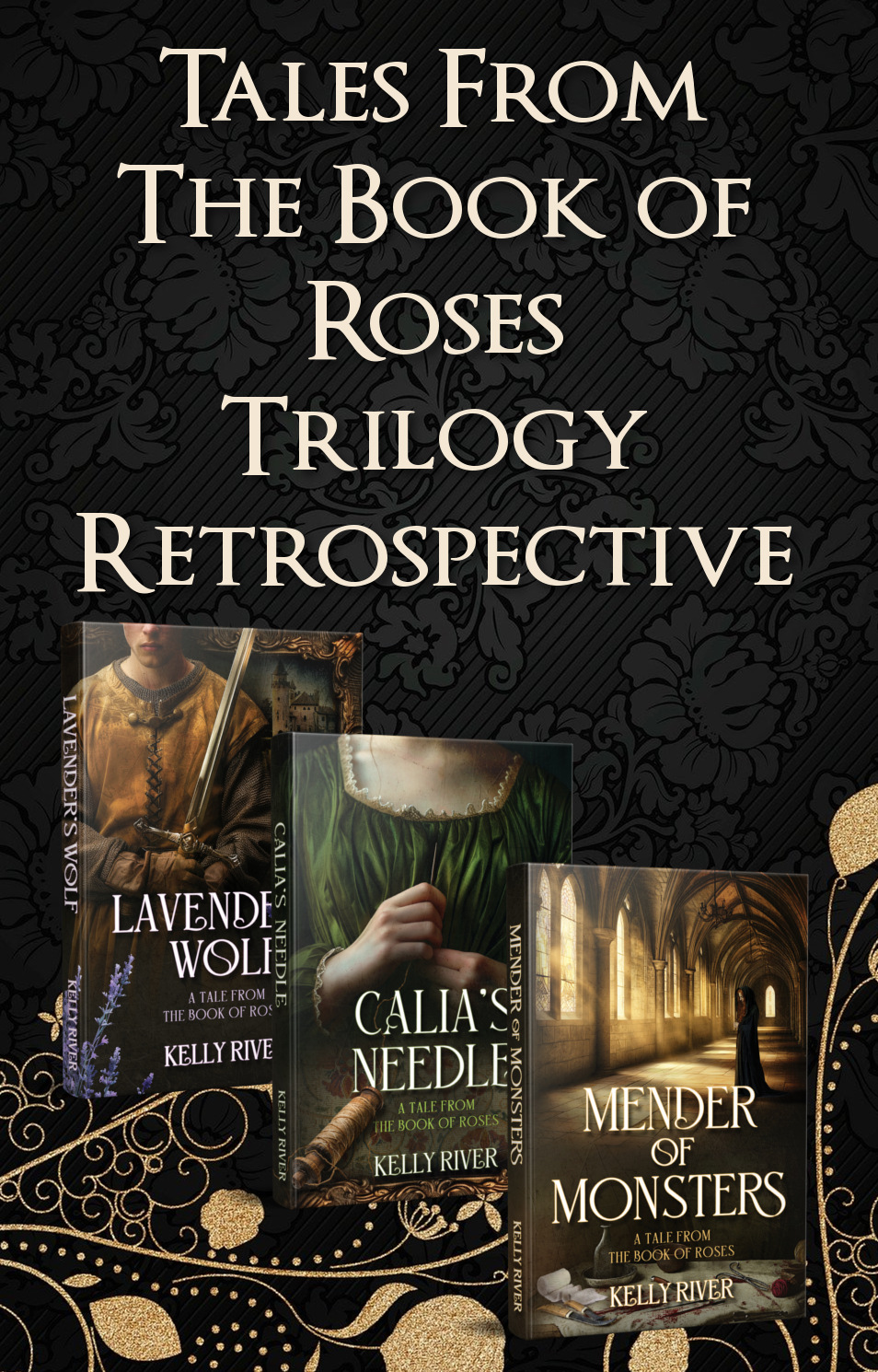
It’s been three months now since Mender of Monsters released, wrapping up the second of three trilogies the Book of Roses series is going to encompass. It wasn’t intended to be a trilogy at first, but that turned out to be a neat little accident that I think ends up fitting the series quite well. Now that a little time has passed, I thought it would be fun to look back on the last three novels and get into some behind-the-scenes details, along with my thought process when writing them.
This post contains spoilers for Calia’s Needle, Lavender’s Wolf, Mender of Monsters, and by extension minor spoilers for The Book of Roses.
The overall goal with the Tales books was to give me a break from the weight of a hefty ongoing story. As an author, you often spend years working on a project like The Book of Roses, and as with any long project, at a certain point you need a breather. For me, stepping back to write some shorter, self-contained novels was the perfect palate cleanser. It was a great way to refresh the creative juices, dip into some narrative threads that might not have survived in a longer story, and just do something different.
The first ideas I had for Lavender’s Wolf and Calia’s Needle came in the form of story threads for The Song of Silver. Before I split Song of Silver off into its own thing, I was considering writing a grand sequel that featured Wolfram, Calia, and Livy as three of the main protagonists. I quickly realised this would present multiple difficulties. Firstly, I don’t like having too many major viewpoint characters in my novels (my loose limit right now is four), which would leave me minimal room to squeeze a villain and love interests into the main cast. Second, I wanted the three siblings to pursue different walks of life, Wolfram as a squire, Calia as an artisan, and Livy as a merchant. This would have made it difficult to have their stories intersect in meaningful ways. It wouldn’t have been impossible, but there was a risk of the book turning into three separate stories running in parallel rather than a single cohesive narrative.
Weighing up these problems, I decided it would make more sense to split the stories into separate books, which led us to…
Lavender’s Wolf
There was a very clear goal in mind with this book: tell a story about knights in shining armour and boys having sword fights. In many ways, it was a response to the more mundane, domestic side of medieval life the first trilogy focused on, instead leaning into the popular trope of the adventurous knight.
Of course, Lavender’s Wolf isn’t really about grand adventures and acts of noble chivalry. It’s more about how the ideas of those things in Wolfram’s head clash with the reality of life as a squire. The princess he falls in love with isn’t pure and innocent, the fights he gets into leave him shaken and changed, and the victories he achieves are more a release from tyranny than a glorious conquest.
I found Wolfram a refreshingly simple, yet somewhat challenging character to write. In line with the traditional hero archetype (and once again going in a different direction than the previous protagonists), I wanted him to solve problems with his brawn rather than his brains. That’s not to say Wolfram is stupid, but I liked the idea of him being a bit of a himbo – beefy, kind, and brave, but not overly bright.
This was a difficult balance to strike, as Wolfram still had to be clever enough to feel like an interesting person who could drive the action forward. In the initial draft, Wolfram was a lot smarter than I wanted him to be, so I made several changes in the manuscript to offload his problem-solving skills onto other characters. In the finished book, it’s usually the people around Wolfram who come up with ideas while he’s the one who puts them into action.
I ended up quite liking Wolfram as a character, and he definitely has room for more stories in the future. Perhaps we’ll see him make an appearance in The Song of Silver, but that’s getting ahead of ourselves. Wrapping up Lavender’s Wolf, I was eager to move on to…
Calia’s Needle
Changing directions again, I wanted to write something that focused on a completely different area of medieval life, perhaps one of the most mundane things I could think of. Rather than clashing swords and deeds of derring-do, I challenged myself to write a character drama centred around tapestry weaving.
Quite early on I realised that in order to do this, I would need to drum up some interpersonal conflicts stemming from the tapestry project. When I began researching how medieval tapestries were made, the creative conflict between the artist and the weavers quickly jumped out at me as a source of tension.
This is only the initial setup, however, quickly giving way to the real domestic conflict between Anastasia and her mother. My main misgiving about Calia’s Needle was that Calia herself wasn’t really the one with the character arc; Anastasia is the person who grows and changes. But it’s only through Calia’s friendship that Ana goes from antagonist to protagonist, and by including her as a secondary viewpoint character we get to see a lot of that turmoil first-hand.
Found family is a fairly prominent theme in all of my novels, and I think Calia’s Needle embodies it the most heavily. While Isaac struggles with similar conflicts in The Book of Roses, Ana’s sense of duty toward her mother clashes with the emotional needs that Karaline and Calia fulfil in a way that brings this theme to the forefront. Familial duty conflicting with personal desires (especially in medieval European culture) is a dramatic conflict that fascinates me endlessly, to the point where I feel like it’s almost impossible for me to write a novel where it doesn’t feature somewhere.
Another storyline I wanted to explore with Calia’s Needle was the redemption of a villain. Ana isn’t really that villainous (especially compared to many of my other characters), but she definitely has some issues to work through. It’s odd, on reflection, that I haven’t done more novels like this, given how satisfying I find moments where protagonists and antagonists find common ground. I’ll almost certainly return to this theme again in the future.
While it’s a lot more low-key than my other books, I had a great time with the cosy pace of Calia’s Needle. It was the sort of warm-down story I’d needed for a while, unlike…
Mender of Monsters
This one came out of the blue. Before writing Lavender’s Wolf, I’d considered other ideas for a shorter, more action-heavy novel that might serve as a secondary entry point into the series. One of my earliest ideas was a prequel about Sir Roger during the war that brought Kaylein and Isaac’s parents to power, but I could never settle on a good idea for it. I didn’t have much interest in writing a whole book about a medieval war (I think that niche is already adequately served in the historical fiction and fantasy genres) and I couldn’t come up with a compelling character story for Roger as a protagonist.
So that idea fell to the cutting room floor, all but abandoned once I wrote Lavender’s Wolf, until I started to muse during a walk one spring day in 2024. I had this idea for a scene – completely detached from any larger narrative – about a kindly nun sitting down to have a frank conversation with a barbarian who might have killed her if he wasn’t incapacitated by a wound. What sorts of things would those two people say to each other? How would the barbarian react to being in a position of helplessness? What could the nun say to try and change someone so fundamentally different from her?
It was a fun scene to ponder, but not one I expected to go anywhere. I thought it might make for an interesting short story, but it was only when I had the idea to make the barbarian Sir Roger that the concept really clicked. It combined the Roger prequel idea with a character conflict that would shift the focus away from the war and into a convent instead.
A second one of those cutting-room-floor ideas that had been lying around for a while was a book set in a nunnery. I’ve always loved the small-scale domestic dramas of nuns and monks living together, and for the longest time I thought I might write a book set in Kaylein’s convent at some point. This idea melded with the Roger prequel to give birth to Mender of Monsters, the first of my “next generation” of novels.
I say “next generation,” because everything prior to this was written well in advance of Elizabeth of Rosepath’s publication. Despite only being released at the tail end of 2023, I had started work on the series all the way back in 2018. Calia’s Needle was finished in 2022, and there was a break of almost two years before I got back to writing Mender of Monsters. This also came with the hindsight of having published and received broader feedback on The Book of Roses, which gave me a new perspective to begin writing from. So, if Mender of Monsters feels different in any way to the previous novels, that’s why!
To some degree, I always feel like my latest novel is my favourite (I probably wouldn’t write them if I thought otherwise), but there are a few things about Mender of Monsters that I have special affection for. I really enjoyed the whole cast of nuns – from the surly Sister Drey to the vain treasuress – but Sister Hazel was a particular favourite. There was something very relaxing about writing a slightly older, wiser protagonist who had her life together in ways my main characters seldom do.
Of all the characters in the Tales trilogy, Hazel is the one I could see myself giving more standalone novels. This isn’t an announcement of anything – if we do see Hazel again, it won’t be for a very, very long time – but I can see space for one or two spin-off books following her life in the years after Mender of Monsters. Unlike Roger, we don’t know what happens to her by the time the events of The Book of Roses occur, so the possibilities are endless!
Well, that about wraps it up for this post. Despite trying to be concise with my thoughts, it still ended up a lot longer than expected. Hopefully some of this was an interesting insight into my creative process when writing the Tales From The Book of Roses series. It might not have been intended as a trilogy, but I think it’s going to end up fitting into the series quite nicely as a bridge between The Book of Roses and The Song of Silver.
Speaking of which, expect another post sometime next month talking more about what to expect from the new trilogy before The Slave and The Sheriff releases this June.
Until then, happy reading!
 Kelly River